
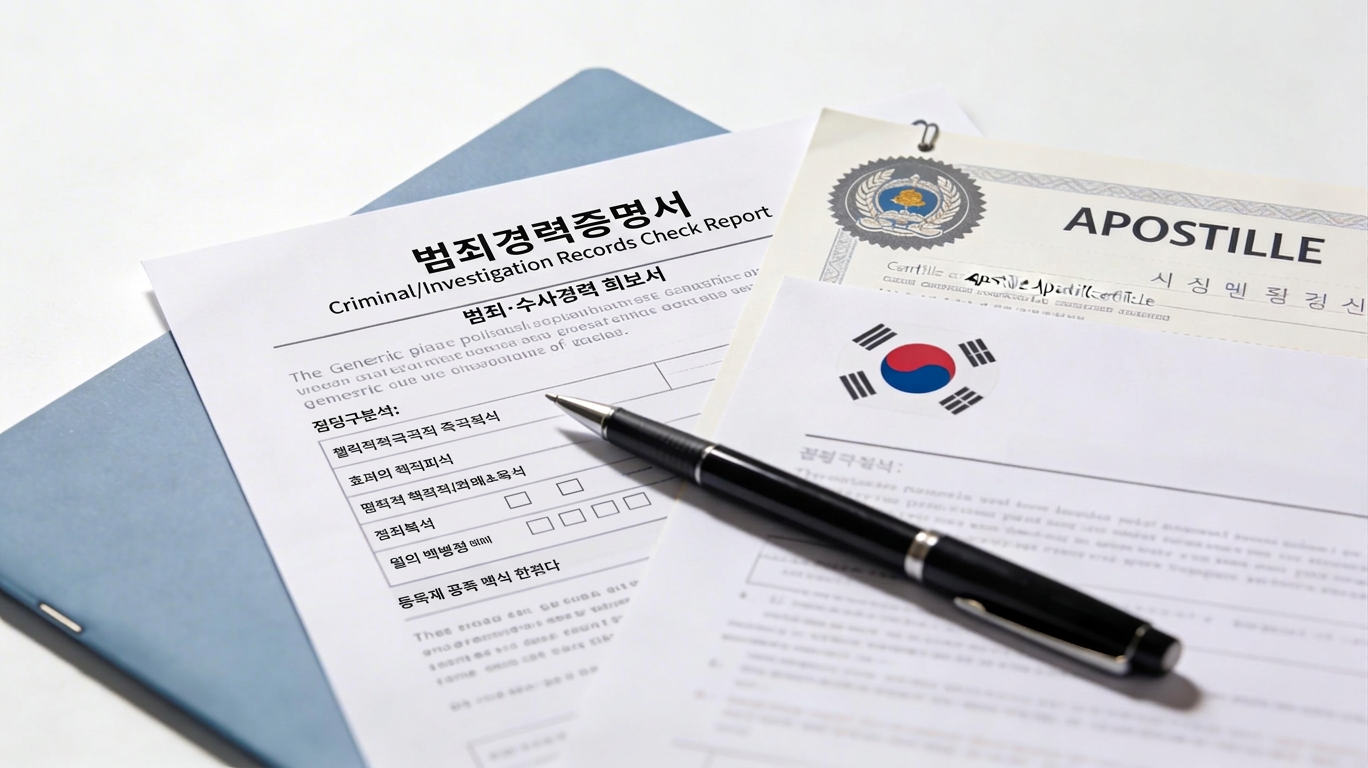
Whether you’re applying for a visa, permanent residency, citizenship, or an overseas job, obtaining a Korean criminal background check, officially called the Criminal (Investigation) Records Check Report (범죄·수사경력 회보서), is often a mandatory step. This guide covers everything you need to know: what the document is, who needs it, how to get it from inside South Korea, how to get it from abroad at a Korean embassy or consulate, and how to get the apostille that many countries require.
What Is a Korean Criminal Background Check?
The Korean criminal background check is an official government document issued by the Korean National Police Agency (KNPA) (경찰청) that confirms whether or not an individual has a criminal record in South Korea. It is known by several names in Korean:
- 범죄경력증명서 (Criminal Record Certificate)
- 범죄·수사경력 회보서 (Criminal/Investigation Records Check Report)
- 신원조사(범죄경력)증명서 (Background Check / Criminal Records Certificate)
The document can be issued as a single combined report or as two separate documents, a Criminal Records Check Report and an Investigation Records Check Report. If issued separately, both must be submitted wherever required.
Who Needs a Korean Criminal Background Check?
You will most likely need a Korean criminal background check in the following situations:
- Applying for a visa or immigration status in another country particularly if you lived in South Korea for 6 consecutive months or longer.
- Applying for permanent residency or citizenship abroad. Immigration authorities in countries like the US, Canada, Australia, and the UK commonly require a criminal background check report.
- International marriage (overseas marriage registration procedures).
- Korean nationals applying for overseas visas. The criminal background check document is normally required for foreign visa or residency permit applications.
- Certain employment situations. Note that by Korean law, the certificate cannot be issued for private employment purposes; the submitting organization must be a government ministry or official agency.
Important: Under Korean law, this certificate is issued only for foreign entry/stay permission purposes (외국 입국·체류 허가용), such as for visa applications, permanent residency, and citizenship. It cannot be issued for private-sector employment screening.
Key Facts About the Certificate
| Feature | Details |
| Issuing authority | Korean National Police Agency (KNPA) |
| Fee | Free of charge |
| Validity | Generally 6 months from issuance; Korean immigration typically treats foreign criminal records as valid for 3 months for visa applications, 6 months for permanent residency |
| Language | Korean and/or English versions available |
| Processing time | Immediate (in-person in Korea); 1–2 weeks (via embassy); up to 30 days (by international mail) |
| Apostille required? | Yes, if submitting to a Hague Convention country |
Please note that we are unable to obtain your South Korean criminal background check on your behalf. This document must be requested and obtained by you directly, as it requires your personal identification and consent. We recommend beginning this process early to avoid any delays with your application.
Part 1: Getting a Korean Criminal Background Check From Inside South Korea
If you are currently living in South Korea, you have two convenient options: visiting a police station in person or applying online.
Option A: Apply Online (Recommended)
The KNPA operates an online portal specifically for this purpose:
- Visit crims.police.go.kr
- Log in using one of four authentication methods, typically your Korean public certificate (공인인증서/공동인증서), KakaoTalk, or mobile phone verification.
- Select the purpose by choosing “외국 입국/체류” (For Foreign Entry/Stay). Do not select “개인 범죄경력 확인” (Personal Criminal Record Check), as that version cannot be printed or submitted officially.
- Fill in your details, including your name, resident registration number (or ARC number for foreigners), and the destination country and agency.
- Download and print the certificate. The certificate is available for download for 5 days only after issuance.
Note: The online system currently requires Windows OS and Internet Explorer or a compatible browser with the required security plug-ins installed. The system is available in both Korean and English.
Option B: Visit a Police Station In Person
- Go to any local police station (경찰서) in South Korea — Korean nationals can visit any station; foreign nationals should visit a station with a foreign affairs division (외사과).
- Bring your passport (and Korean ID or ARC card for foreigners).
- Fill out the application form available at the station — select “외국 입국/체류 허가용” as the purpose.
- No fee — the certificate is issued free of charge, usually on the spot for Korean nationals.
For foreign nationals currently in Korea: You are eligible if you have lived in South Korea for 6 consecutive months or longer since the age of 18. You will need your passport, and if applicable, your Alien Registration Card (ARC).
Part 2: Getting a Korean Criminal Background Check From Abroad
If you are outside South Korea, there are three main routes to obtain the certificate.
Option A: Apply at a Korean Embassy or Consulate (Most Common)
Since June 1, 2016, Korean embassies and consulates around the world have been issuing Criminal Background Check (Criminal Records) Certificates electronically in cooperation with the KNPA. This is the most accessible option for those living abroad.
Who qualifies:
- Korean nationals aged 14 or older living abroad who need the certificate for a foreign visa, permanent residency, or citizenship application.
- Foreign nationals who have previously lived in South Korea and need the certificate for immigration purposes.
Required documents:
- Application form (신원조사(범죄경력)증명 신청서) — must be completed by hand (not typed)
- Passport-size photo taken within the last 6 months (3×4 cm)
- Valid original passport
- If you obtained a new passport: bring the old passport you used while in Korea as well
- Copy of your Alien Registration Card (if applicable)
- Copy of Korean visa (if applicable)
Additional documents for specific cases:
- Foreign nationals: 외국인등록사실증명원 or copy of ARC
- Korean nationals without a resident registration number back number (주민등록 뒷번호 미부여자): 기본증명서
- Korean nationals under 19: 기본증명서
- Korean nationals who have changed their name: 기본증명서 (상세)
How to apply:
- Visit the Korean embassy or consulate in person — applications sent by post are generally not accepted at the consular window.
- An embassy officer verifies your identity using your passport.
- Your application is transmitted electronically to the KNPA in Korea.
- Processing takes approximately 7–10 business days.
- You may pick up the certificate in person or, if you provide a prepaid return envelope, it can be mailed to you.
Tip: Always book an online appointment before visiting your Korean embassy or consulate, as walk-ins may not be accepted at all locations.
Option B: Apply Directly to the KNPA by International Mail
If visiting a Korean embassy is not feasible, you may apply directly to the Korean National Police Agency by international courier. This option generally requires a fingerprint identification document from your country’s police authority.
Required documents (in addition to the standard documents above):
- Completed application form (handwritten)
- Fingerprint card completed at a local police station in your country
- Passport copy
- Passport-size photo
- Return self-addressed envelope with international postage (if you want it shipped to you)
- Letter of Authorization (LOA) for Korean Apostille to pickup the document from the police office for notarized translation and/or apostille. Contact Korean Apostille for more details.
Processing time: Approximately 30 days after receipt, due to the added fingerprint verification step.
Mail your package to the KNPA’s Criminal Analysis Division at:
Korean National Police Agency
Criminal Analysis Division (범죄분석과)
97 Tongil-ro, Seodaemun-gu, Seoul 03739, Republic of Korea
Tel: +82-2-3150-2676
Option C: Apply Online (For Korean Nationals With a Valid Korean Certificate)
Korean nationals who possess a valid Korean public certificate (공동인증서) may be able to apply online through crims.police.go.kr from abroad, provided they have the required software and authentication tools. This option is generally easier for those who maintained their Korean digital certificates while living overseas.
Part 3: The Apostille — Why You Need It and How to Get It
Once you have your Korean criminal background check in hand, many countries will require an apostille to be attached before the document is legally recognized internationally.
What Is an Apostille?
An apostille is an official authentication stamp or certificate issued under the Hague Apostille Convention that certifies the authenticity of a public document, so it can be accepted in other member countries without requiring further legalization by an embassy. South Korea joined the Hague Apostille Convention, meaning Korean government documents including criminal background checks can be apostilled for use in the 125+ member countries of the Convention.
If the destination country is not a member of the Hague Convention (e.g., some Middle Eastern, African, and Southeast Asian countries), you will need embassy legalization instead, which is a different process.
Who Issues Apostilles in South Korea?
In South Korea, apostilles on criminal background check certificates are issued by the Ministry of Foreign Affairs (외교부, MOFA). Only central government authorities can issue apostilles, not local city offices.
How to Get an Apostille on Your Korean Criminal Background Check
If you are physically in South Korea:
- Obtain your criminal background check from the KNPA online portal (crims.police.go.kr) or from a police station.
- Visit the Ministry of Foreign Affairs apostille counter in Seoul (or apply online if eligible — an online apostille service is available for certain documents through the KNPA/MOFA joint system).
- Submit your application by filling out the apostille request form, present your passport, and pay the stamp fee (approximately 1,000 KRW per document).
- Processing time is normally 2–3 business days, with same-day service sometimes available.
- Pick up your apostilled document in person, or arrange international delivery via DHL or another courier.
Online Apostille Option: South Korea’s KNPA and MOFA jointly offer an online apostille issuance service for criminal background check certificates. If you have a valid Korean public certificate (공동인증서), you can apply via the KNPA portal, obtain your criminal record certificate, and simultaneously request the apostille all online.
If you are outside South Korea:
If you are living abroad and cannot travel to Korea, getting the apostille requires either:
- Giving power of attorney to a trusted person in Korea, who can go through the steps above on your behalf
- Using a professional apostille service based in Korea that can obtain both the certificate and the apostille for you, with international shipping
Using a Professional Service: The Easiest Option for Those Abroad
Navigating the Korean bureaucratic system, especially from overseas can be complicated. Between visiting embassies, mailing documents internationally, obtaining authentication certificates, and coordinating Korean-language paperwork, the process can take weeks or longer if done independently.
Korean Apostille (koreanapostille.com) is a professional service specializing in obtaining and apostilling Korean documents for clients worldwide. The team can:
- Handle the apostille process
- Arrange certified translation if required by your destination country
- Coordinate notarization services if needed
- Ship all completed documents directly to you anywhere in the world via secure international courier
This is particularly valuable for people who no longer live in Korea and do not have a trusted contact in the country, or who want to ensure the process is handled correctly the first time, avoiding costly delays and rejected documents.
Frequently Asked Questions
Can a foreign national get a Korean criminal background check?
Yes. Foreign nationals who have lived in South Korea for 6 consecutive months or longer since the age of 18 are eligible to apply. This is commonly required for immigration applications in countries like the US, Canada, Australia, and others.
Is the certificate issued in English?
Yes. You can request the certificate in English (영문) when applying. When applying online at crims.police.go.kr, simply select “영문” (English) as the document language. Embassies also issue the English version.
How long is the Korean criminal background check valid?
The certificate itself does not have a fixed legal expiry date, but practically speaking, most foreign immigration authorities treat it as valid for 6 months from the issue date. Korean immigration authorities for visa purposes generally consider a foreign criminal record certificate valid for 3 months for short-stay visa applications and 6 months for permanent residency applications.
Can the certificate be used for employment at a private company?
No. Under the Act on the Lapse of Criminal Sentences (형의 실효 등에 관한 법률), this certificate can only be issued for foreign entry/stay permission purposes. It cannot be issued for private-sector employment. The submitting organization must be a government ministry or official authority.
What if I need the lapsed records included?
Certificates obtained through Korean embassies and consulates abroad do not include lapsed records (실효된 형). If you need lapsed records included (which some countries like Canada specifically require), you must apply in person at a police station inside South Korea or engage a Korean legal professional or authorized service to handle the application on your behalf.
Do I need a fingerprint card?
If applying by international mail directly to the KNPA, a fingerprint card from your local police authority is typically required. If applying in person at a Korean embassy or consulate, fingerprints are generally not required.
My destination country is not in the Hague Convention. What do I do instead of an apostille?
For non-Hague countries, your document will need to go through embassy legalization, a process involving the Korean Ministry of Foreign Affairs and then the destination country’s embassy in Seoul. Professional apostille and legalization services such as koreanapostille.com can handle this process as well.
Step-by-Step Summary For a South Korean Criminal Background Check Apostille
Scenario 1: Currently living in South Korea — need certificate for use abroad
- Visit crims.police.go.kr or go to your local police station
- Select purpose: “외국 입국/체류” (Foreign Entry/Stay)
- Request English version if needed
- Apply for apostille at the Ministry of Foreign Affairs (online or in person)
- Arrange international courier delivery to your destination
Scenario 2: Living abroad — Korean national needing certificate for immigration
- Visit your nearest Korean embassy or consulate in person with required documents
- Wait approximately 7–10 business days for the certificate to be issued
- Once received, submit the certificate to a professional apostille service in Korea (or use the embassy’s apostille service if available)
- Have apostilled document couriered to you or to the receiving authority
- Or: Contact koreanapostille.com to handle the entire process for you
Scenario 3: Foreign national who lived in Korea, now abroad — needs Korean certificate
- Visit the nearest Korean embassy or consulate in person with your passport and documentation of your time in Korea
- Wait up to 2 weeks for processing
- Arrange apostille processing through a Korean professional service
- Contact koreanapostille.com — the team can coordinate the apostille, and notarized translation end-to-end from Korea
Contact Information & Resources
| Resource | Details |
| KNPA Online Certificate Portal | crims.police.go.kr |
| KNPA Contact (Criminal Analysis Division) | +82-2-3150-2676 |
| Ministry of Foreign Affairs (Apostille) | +82-2-2100-8170 |
| Korean Apostille Professional Service | koreanapostille.com |
Getting a Korean criminal background check, and ensuring it is properly apostilled, does not have to be a frustrating process. Whether you are in Korea or on the other side of the world, understanding the correct steps and using a trusted professional service ensures your documents are issued correctly, authenticated properly, and delivered on time.